
See where care is now—and where it may be heading.

Family Care Horizons™ is a care planning framework that helps families understand how care changes over time, recognize when the system is becoming harder to sustain, and make more intentional decisions about what comes next.
What Family Care Horizons™ helps you see
Family Care Horizons™ gives families a shared way to see the care journey—not as a series of isolated crises, but as a system that changes over time.
How care changes over time
“Helping out” can become a care system
Pressure may build before things break
Early action can preserve choice, dignity, and relationships
Family Care Horizons™ helps families and individuals name where they are now—before decisions harden and options narrow.
What Family Care Horizons™ helps you see
Care Horizons™: Where are you now?
Family Care C-suite™: Which leadership responsibilities do you carry?
Care Archetypes™: Which roles do you play?
Care Load Map™: How do you share the Care Load?
Care Stability Signals™: What risks and sources of strain are growing?
The core insight: Stability Drift™
Care needs change. Health, cognition, safety, daily support.
Family capacity changes. Time, energy, coordination, decision load, availability.
The system changes. What worked before may no longer be sustainable.
Family Care Horizons™ helps families notice these shifts earlier—while there may still be more choices available.
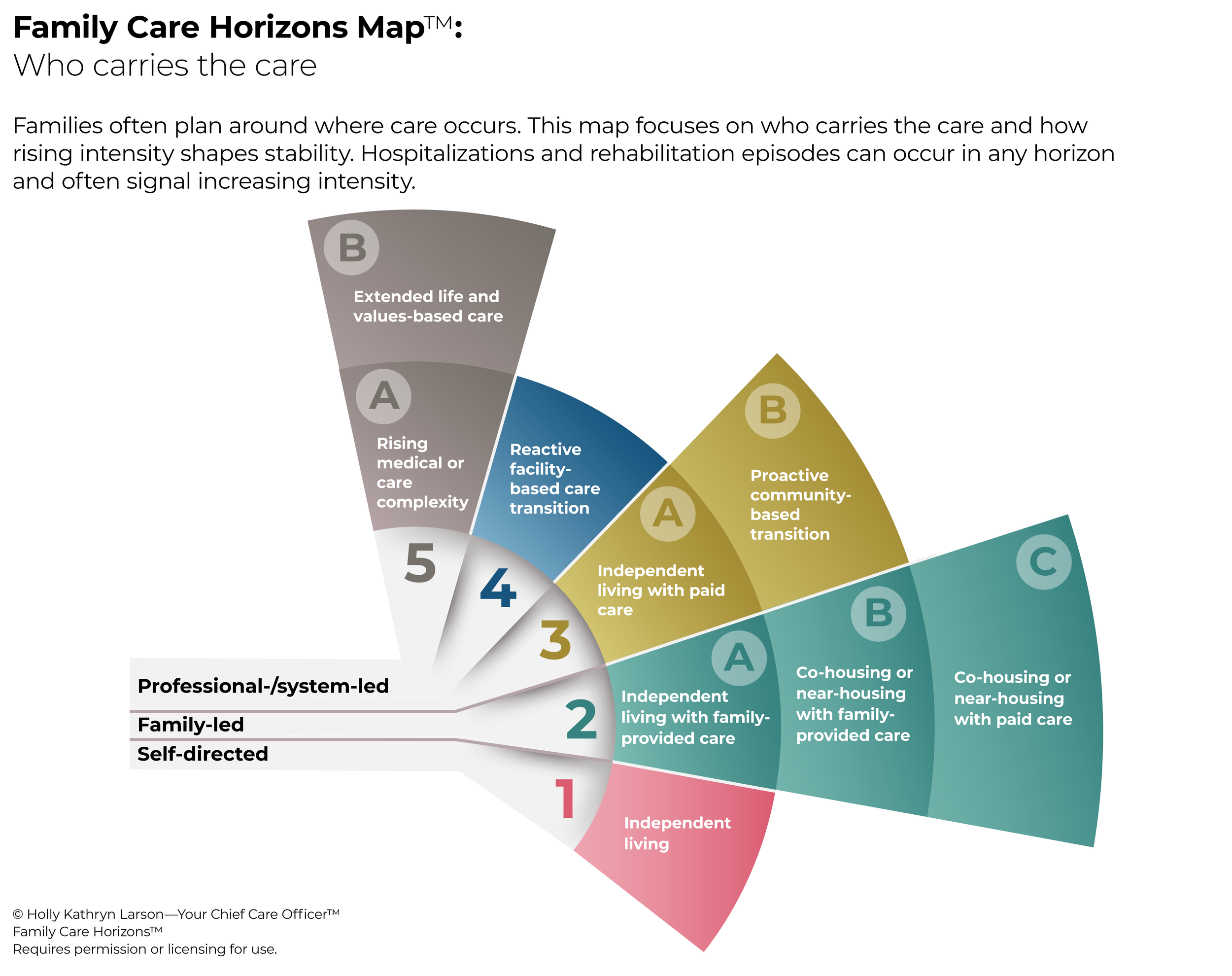
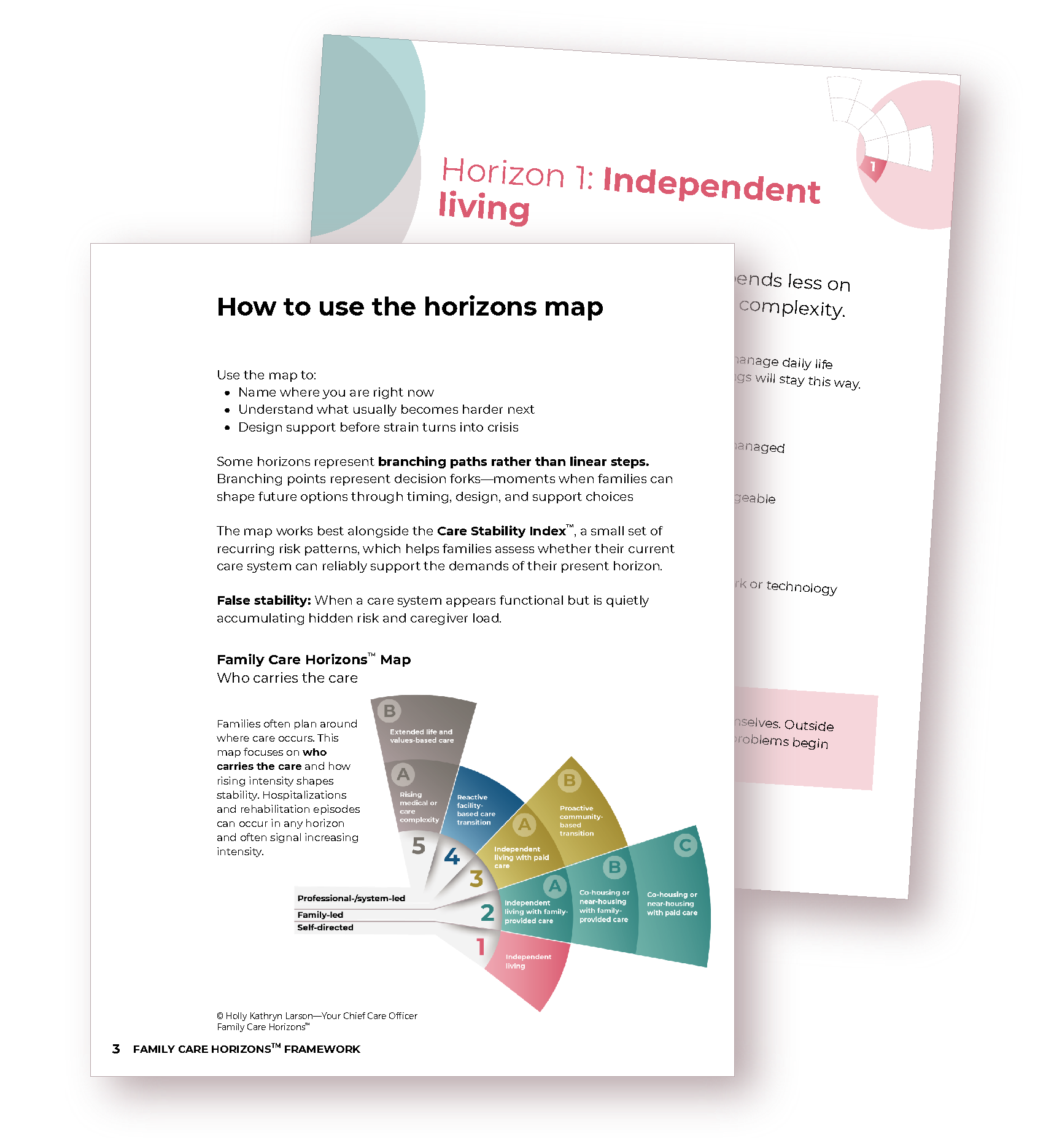
Family Care Horizons™ Map
A visual model of how care evolves and who holds the care.
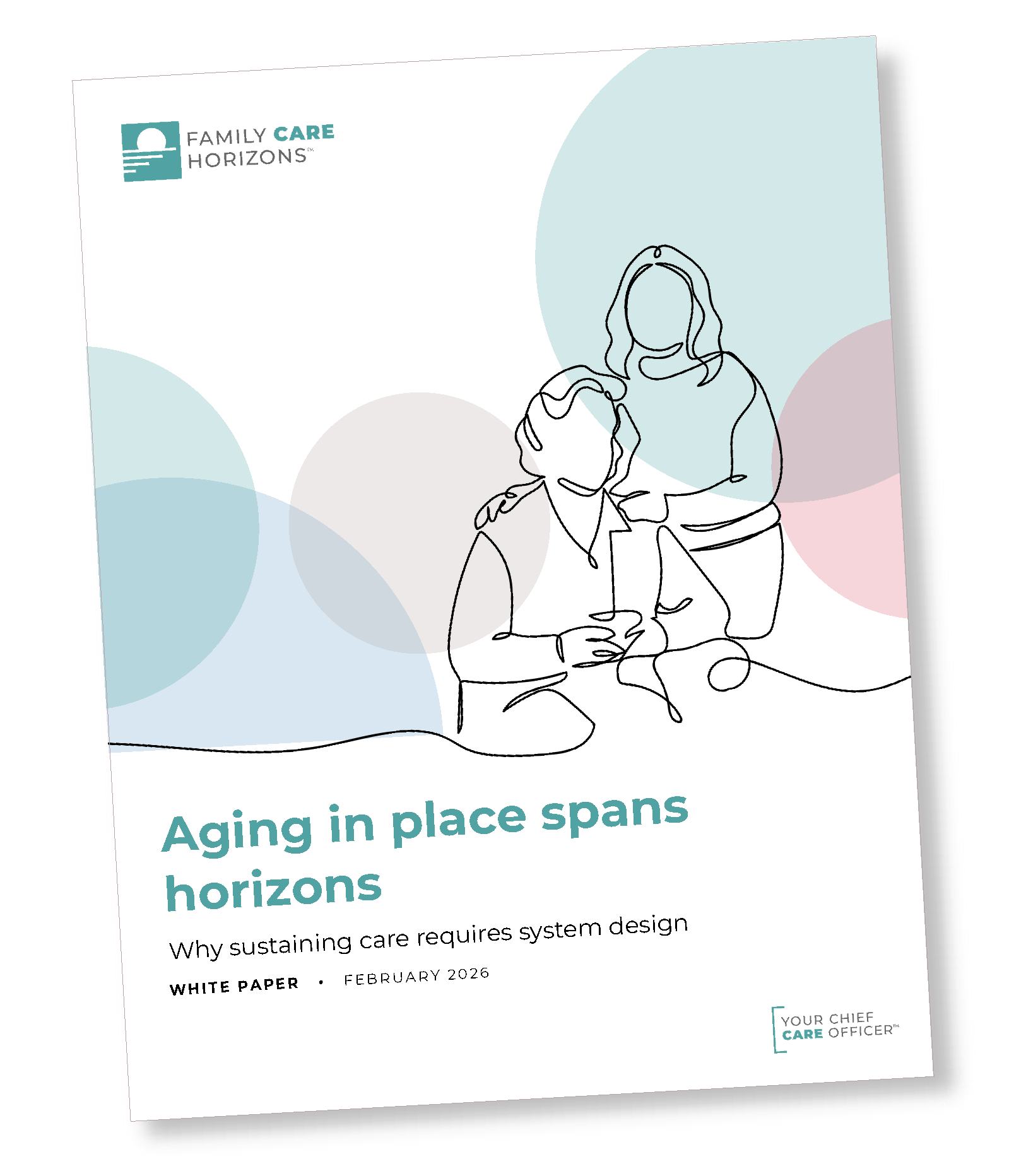
Aging in place spans horizons
Why sustaining care requires system design
Shows that care flows across horizons—and that who carries the care matters more than where it is delivered.
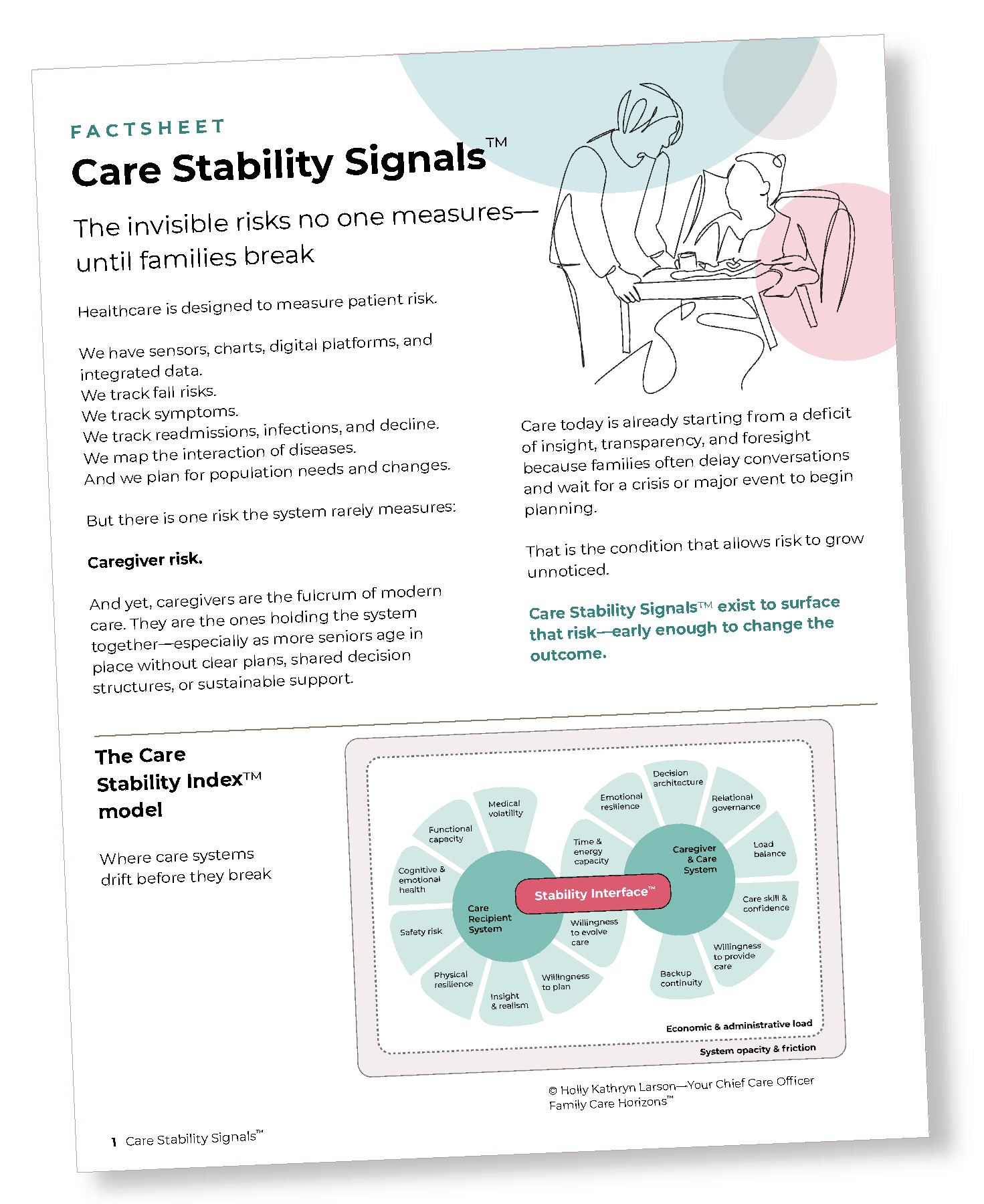
Care Stability Signals™
Early warning patterns of care strain
Identify small shifts in time, coordination, care needs, and human capacity that signal a system may be becoming fragile.
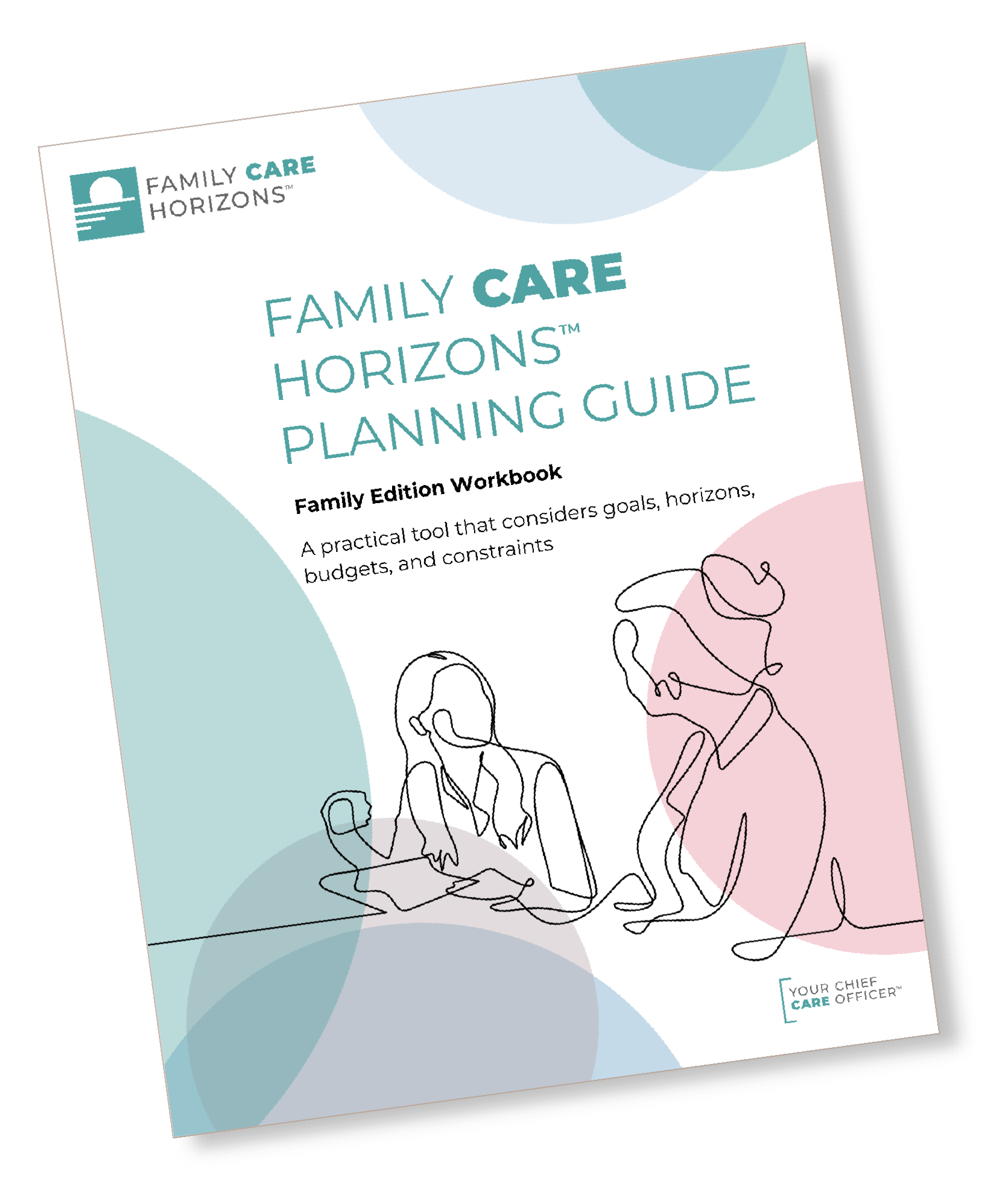
The Family Care Horizons™ Planning Guide
Envision what a care plan could include: real-world support options, budget ranges, tradeoffs, resources aligned with Care Horizons, and design options you may not have considered.
The Care Operating System™ (Care OS)
Learn how to plan: Think about care as a system, how decisions evolve over time, and how to redesign care before crisis forces action.
See where you are. Understand what's changing. Design what comes next.


Note: When we say family, we mean anyone involved in supporting someone’s care—including parents and adult children, partners, friends, neighbors, and community or faith-based supporters. Individuals planning for their own care can also use these tools.
Frequently Asked Questions
-
Care horizons describe the most common ways care is organized—from independence to more complex support needs. Care horizons are organized by who primarily holds the care: the individual, the family, or professionals and systems.
Rather than predicting exactly what will happen, Family Care Horizons™ helps families understand how care commonly evolves and what decisions tend to emerge at different stages.
For example, some families begin with independent living, later add family support, then paid care, and eventually consider assisted living or memory care. Others skip stages entirely or move between them.
The goal is not necessarily to “advance” through horizons. The goal is to stay stable within the right horizon for your family’s needs.
-
Some older adults remain independent for years. Others experience gradual decline, sudden medical events, or increasing cognitive needs that require new types of support.
As care evolves, families often move from occasional help to coordination, oversight, hands-on care, paid caregiving, or facility support.
These planning tools help families anticipate these shifts so decisions feel more intentional—and less reactive.
-
Yes. Care horizons are not linear.
Families may remain in one horizon for years, skip ahead after a crisis, or even move backward if health stabilizes or supports improve.
For example, a parent recovering from illness may temporarily require intensive support and later return to greater independence. Similarly, families often continue providing oversight and advocacy even after a loved one transitions into assisted living or memory care.
Care evolves—and good planning evolves with it.
-
Aging in place may no longer be the best fit when safety concerns, medical complexity, isolation, caregiver burnout, or coordination demands begin exceeding what seniors and families can support.
Signs might include medication errors, falls, wandering, repeated hospitalizations, growing caregiver exhaustion, or increasing stress around daily logistics.
Our frameworks encourage families to look not only at the care recipient’s needs, but also at caregiver sustainability. A care arrangement that only works through exhaustion may no longer be stable.
-
Families today have more options than many people realize.
The Planning Guide explores 16 innovative care models such as co-housing with family, village networks, wellness communities, hospital-at-home services, neuro-responsive dementia housing, distributed care delivery, and care cooperatives.
Families are using these alternatives to redesign care beyond traditional facility pathways.
-
Many families layer care across horizons rather than living in one clearly defined stage.
For example, someone may technically live independently while receiving extensive support from adult children, paid caregivers, community programs, or remote monitoring.
The care horizons are planning lenses—not rigid categories. Their purpose is to help families understand patterns, anticipate decisions, and identify what type of support may be needed next.
-
Planning early allows families to discuss goals, financial realities, housing options, medical wishes, caregiver roles, and future tradeoffs before emotions are high.
However, families can use our frameworks at any point. Whether your loved one is healthy, managing chronic illness, experiencing dementia, or transitioning to higher levels of care, planning can still improve clarity and reduce overwhelm.
-
Yes. In fact, families often find these frameworks are most helpful when used collaboratively.
Caregiving becomes easier when expectations, responsibilities, and tradeoffs are discussed openly rather than assumed.
The Care Operating System™ includes tools for clarifying roles, aligning decisions, reducing conflict, and creating a shared care plan that can evolve over time. It is particularly helpful for siblings or geographically dispersed families trying to coordinate care together.
The Planning Guide helps families understand care as a system, exploring how care changes across care horizons, identifying early signs of strain, and discovering which resources and innovative models are most relevant at any stage.
-
Explore the Planning Guide, Care Operating System™, and free caregiving resources.