
Insights
Ideas and frameworks for seeing care differently
Family care is often experienced one problem at a time: an appointment, a decision, a transition, a new diagnosis, a conflict, a crisis.
But underneath those individual moments is a system.
Your Chief Care Officer™ develops original research, frameworks, and practical tools that make that system easier to see, understand, and lead.
Explore the ideas shaping Care Like a Leader™—from how care systems become unstable to how families can anticipate change, make better decisions, and design care more intentionally.
Care is personal. The challenges are often structural.
Care is becoming one of the most complex operational realities facing families, employers, and healthcare systems—yet it is still largely managed as a private, informal responsibility.
Much of the work here starts with a different question: What becomes possible when we stop treating every care challenge as an isolated problem and start seeing the system around it?
Featured research

NEW | June 2026
The Care Vortex™
A systems hypothesis for why family care becomes increasingly unstable over time.

Understand how care actually works
The Hidden Architecture of Care™
A system-level view of how caregiving actually works across time, roles, and decisions.
Care Archetypes™
A system-level map of the roles families step into to stabilize complex care—showing how work concentrates across layers, where strain builds, and why it becomes unsustainable when carried alone.
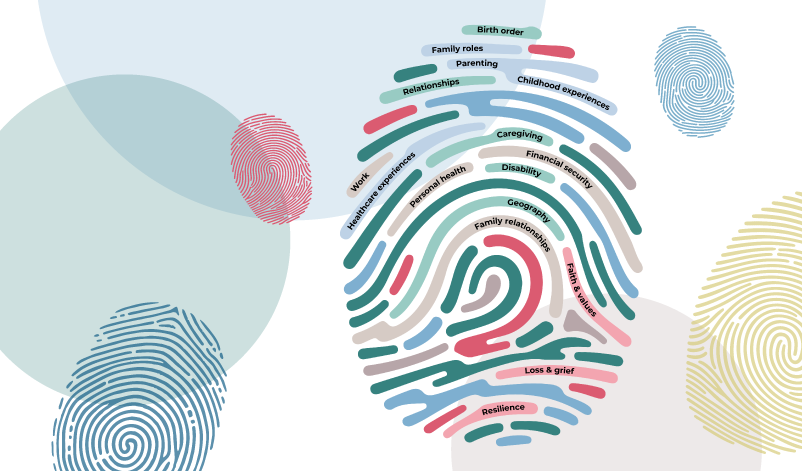
Care Fingerprint™
Why there is no one right way to care: Explore how life experiences, relationships, values, beliefs, and circumstances shape how each of us thinks about giving, receiving, and planning for care.

The Visual Architecture of Care™
See the hidden patterns shaping family care: Explore a growing collection of visual frameworks that make care load, relationships, risk, capacity, and system dynamics easier to see and understand.
See change before crisis
WHITE PAPER
Aging in place spans horizons
Why sustaining care requires system design
Reframes aging in place as an evolving care infrastructure rather than a static goal—and explains why most families plan too late.
Family Care Horizons™ Framework
A structural map of how care evolves over time
Maps the recognizable phases of caregiving and shows where pressure typically builds as needs intensify and support systems change.
Provides a shared planning lens for understanding transitions, escalation, and system dependence.
Care Stability Indicators™
Early indicators of system fragility: Identifies the observable patterns that reveal when a care system is becoming unstable — across time, coordination, care needs, and human capacity.
Designed to make structural risk visible before crisis forces intervention.
WHITE PAPER
The hidden risk surface in the care economy
Why care system stability must be measured as infrastructure
This paper introduces a systems framework for making care system fragility visible before crisis occurs, including structural models for mapping care domains, care load distribution, and early stability signals.

Designing and Managing Your Care System
Creating Your Family Care Framework
A short starter worksheet to help families and individuals clarify goals, roles, and priorities before using the full Care Operating System.™
Care Stability Signals™ Fact Sheet
Recognize when a care system may be becoming unstable: Learn the patterns that can signal rising risk for the person receiving care, the caregiver, or the care system—and when it may be time to reassess capacity, responsibilities, or support.
Choosing a medical rehab or skilled nursing facility
A checklist for what families need to evaluate—before a clinical transition.
Managing a clinical transition
A checklist for what families must actively do—once the transition begins.
Care Operating System™
A decision-making system for designing and adapting family care over time: Move beyond day-to-day task management with a practical system for setting direction, understanding capacity, recognizing instability, making decisions, and adapting as care changes.
Designing a Life with Care™
Start with the life you want—not the care solution: A practical workbook for exploring what matters most, imagining possibilities, testing options, and designing care around the life you and your family want to create.

Family Care Horizons™ Planning Guide
See where care is today—and what may come next: Explore care options, costs, resources, and emerging models across the Care Horizons, with practical tools for recognizing strain and planning before circumstances force a decision.
Keep exploring
Care by Design newsletter
Coming soon! A weekly reflection on how families design, adapt, and sustain care over time—with emerging trends, system insights, and early access to new tools and resources.
Bring these ideas into your organization
Organizations across healthcare, finance, benefits, care delivery, and technology are beginning to treat care as operational infrastructure.
Your Chief Care Officer™ works with leaders and organizations exploring:
caregiver and workforce strategy
care system strategy
care navigation and experience design
early risk identification
decision frameworks for families and clients
integration of care frameworks into programs, platforms, and services


Note: When we say family, we mean anyone involved in supporting someone’s care—including parents and adult children, partners, friends, neighbors, and community or faith-based supporters. Individuals planning for their own care can also use these tools.
Frequently Asked Questions
-
Your Chief Care Officer explores the realities of caregiving and aging through practical frameworks, systems thinking, and real-world experience on this website and LinkedIn (@HollyKLarson).
Topics we cover include caring for aging parents, sibling caregiving dynamics, remote caregiving, aging in place, care planning and decision-making, family conflict and communication, financial and housing considerations, dementia and cognitive decline, innovative care models, caregiver identity and emotional strain, caregiving burnout and overwhelm, and the future of caregiving.
The goal is to help families think more clearly about difficult decisions and evolving care needs.
-
The best time to plan is before a crisis limits options.
Early conversations about housing, finances, healthcare wishes, caregiver roles, and support systems can make later decisions far less stressful.
However, it is never too late to start.
Many families begin planning after a diagnosis, hospitalization, fall, or caregiving crisis. Better planning can still improve outcomes and reduce overwhelm.
-
Aging in place stops working when the current setup is no longer safe, sustainable, or realistic for the family.
Signs may include falls or wandering, medication mistakes, increasing isolation, caregiver exhaustion, repeated emergencies, rising medical complexity, and daily logistics becoming unmanageable.
The question is not simply: Can someone stay at home?
It is also: Can the care system supporting home remain sustainable?
Sometimes the answer is yes—with added support. Sometimes families need to consider new care arrangements.
-
Many caregiving challenges are understandable—and common.
Families often wait too long to plan, avoid difficult conversations, assume adult children can do everything, underestimate how care may evolve, make decisions only during crises, overlook caregiver burnout, fail to discuss financial realities early. This can lead to unrealistic expectations and reactive decision-making.
No family handles caregiving perfectly. But understanding common patterns can help families make more informed, sustainable choices.
-
There is no single right way.
Responsibilities often depend on willingness, geography, work schedules, emotional bandwidth, finances, skills and comfort levels, boundaries, and family dynamics.
One person may handle medical advocacy while another manages finances, transportation, logistics, or emotional support.
What matters most is clarity. Caregiving tends to work better when expectations are discussed openly instead of assumed.
The Care Operating System™ helps families clarify responsibilities and reduce misunderstandings.
-
Families today have more options than many people realize. Depending on needs and resources, alternatives may include co-housing with family, village networks, wellness communities, home-based care with technology, hospital-at-home services, neuro-responsive dementia housing, care cooperatives, and distributed care delivery.
The Planning Guide explores these emerging care models and how families are redesigning care beyond traditional facility pathways.
-
Caregiving often expands gradually until one person is carrying far more than is sustainable.
When this happens, families may need to redistribute responsibilities, bring in paid support, simplify expectations, revisit living and care arrangements, explore community or professional resources, or rethink the care plan entirely.
Burnout is not a sign of failure. It is often information that the current system no longer fits the level of need.
-
Families are balancing work, parenting, finances, emotions, medical uncertainty, family dynamics, and changing responsibilities—all at once.
Many caregivers are navigating unfamiliar systems while making difficult decisions with imperfect information.
Caregiving can be meaningful and loving while still being emotionally and physically exhausting.
Our work exists to help families navigate that complexity with greater clarity, structure, and support.
-
Explore the Planning Guide, Care Operating System™, and free caregiving resources.